Huawei Unveils Mate XT 2 Tri-Fold Smartphone With Kirin 9050 Pro
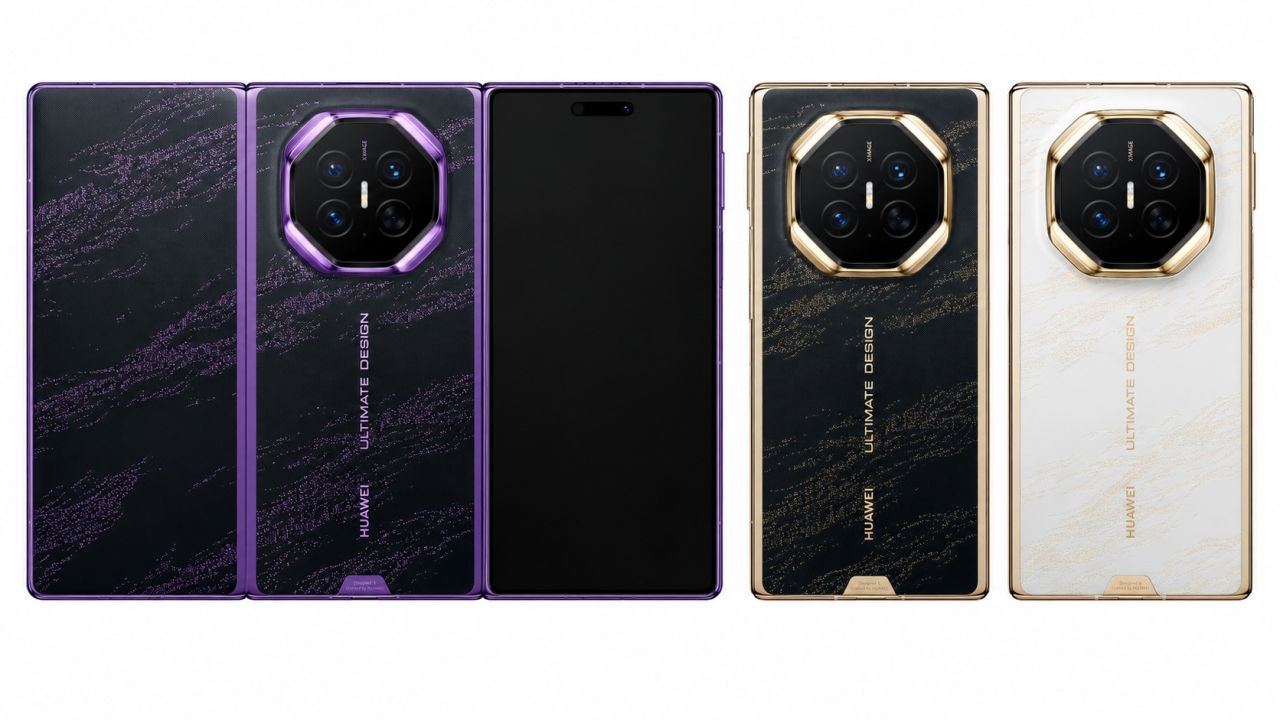
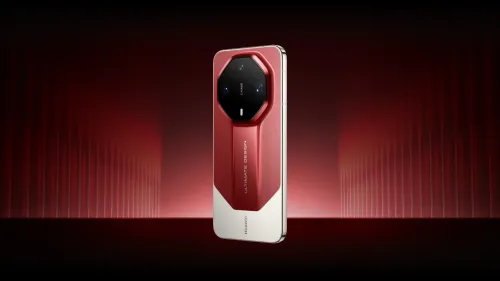
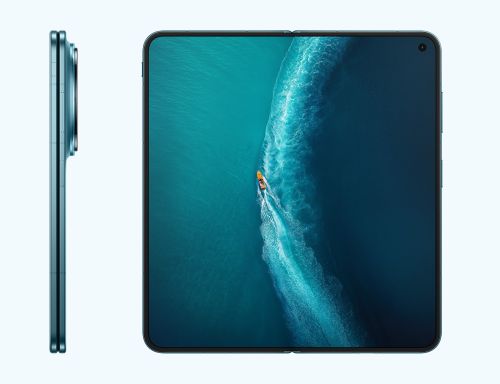
Huawei has shown the second generation of its tri-folding smartphone, the Huawei Mate XT 2 Ultimate Design. The key difference from the original Mate XT lies in the mechanism: both side sections now fold inward, so the flexible panel is fully tucked away inside the body. Along with the redesigned hinge, the device gains a proper outer screen, Huawei's in-house Kirin 9050 Pro platform and HarmonyOS 7.
An inward fold and a usable outer screen
On the original Mate XT the flexible display stayed on the outside even when the phone was closed, which raised the most questions about durability. Huawei has now moved to what it calls a wing-style fold: the side panels wrap inward and the main screen ends up sealed inside the chassis. The hinge has been reworked, and the body is rated IP58 and IP59.
Fully opened, the phone starts at 3.5 mm thick and weighs 299 g, which for a 10.2-inch panel remains one of its strongest arguments. Closed, it grows to 12.3 mm. The main display uses UFG ultra-flexible glass, runs at an LTPO-driven 1–120 Hz and relies on 1440 Hz high-frequency PWM dimming.
The most noticeable everyday change is the separate 6.5-inch outer screen. Built on a rigid dual-layer OLED panel, it handles calls, messages and QR-code payments without unfolding the phone at all. The previous generation had no equivalent.
Huawei also offers a version with a hardware privacy display based on its Ling Shield technology. A double tap switches the screen between the standard view and a mode in which the image cannot be read from the side.
Kirin 9050 Pro and connectivity
The Mate XT 2 is the first phone to ship with the Kirin 9050 Pro. Huawei describes it as a mass-produced chip built on a logic-folding architecture, with compute blocks stacked in vertical layers to shorten the signal path between them. The processor uses nine cores: one prime, two performance, four efficiency and two little cores.
According to the company, peak single-core performance is up 24% and multi-core performance up 52%, with an overall 42% gain over the Mate XTs. The Maleoon graphics supports real-time ray tracing, where Huawei claims a 142% increase in rendering speed. No independent measurements confirming these figures are available yet.
A Balong modem is integrated into the chip, so the phone covers 5G, eSIM, Wi-Fi 7, UWB and NearLink. Beyond conventional networks, it supports Tiantong satellite calling, BeiDou satellite messaging and low-earth-orbit broadband satellite connectivity. Cooling is handled by a large vapour chamber and a graphene heat-dissipation system.
Cameras and health measurements
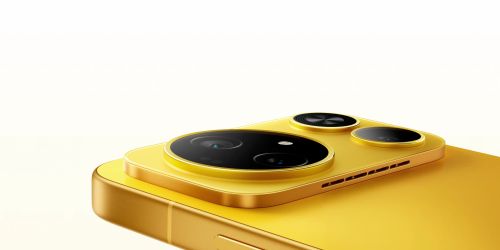
The camera unit is built around a 50 MP RYYB sensor of 1/1.28-inch format with a variable F1.49–F4.0 aperture, optical stabilisation and LOFIC technology for wider dynamic range. It is joined by a 40 MP ultra-wide module and a 50 MP periscope with 3.5x optical zoom. A separate multi-spectral colour sensor handles tonal accuracy, while 8 MP selfie cameras sit on both screens.
An optical sensor built into the camera unit measures heart rate, ECG and blood oxygen. The user places a finger on it and the readings are passed to the Huawei Health app.
HarmonyOS 7 and the large-screen experience
The software has been adapted to the dual-hinge layout, with flexible multi-window arrangements, data hand-off between apps and multi-screen collaboration. Opened up, the phone is meant to work as a compact tablet, while the outer screen covers ordinary phone tasks.
The Android compatibility layer has been removed from HarmonyOS 7. According to Huawei, every function of the phone now runs inside the company's own software environment.
The launch lands at a busy moment for foldables: Xiaomi has just shown the 18 Fold and Apple is preparing a folding iPhone of its own. Reuters reports that Huawei accounted for 68% of foldable smartphone shipments in China in the second quarter of 2026.
The phone was introduced on 7 September at the HarmonyOS 7 event in Guangzhou, and Chinese sales start on 12 September at 10:08 local time. Pricing begins at CNY 19,999 (~$2980) for the 16/256 GB version and reaches CNY 24,999 (~$3725) for the privacy-display model, while the 2 TB collector edition costs CNY 29,999 (~$4470).
Specifications
- Main display: 10.2" LTPO OLED, 2232 x 3184 pixels, 1–120 Hz, 1440 Hz PWM, UFG glass
- Outer display: 6.5" LTPO OLED, 1140 x 2442 pixels, 120 Hz, Xuanwu Kunlun glass
- Chipset: Kirin 9050 Pro, nine cores, Maleoon GPU, Da Vinci NPU
- Memory: 16 GB RAM, 256 GB / 512 GB / 1 TB (2 TB in the collector edition), no card slot
- Rear cameras: 50 MP RYYB 1/1.28" with F1.49–F4.0 and OIS, 50 MP periscope with 3.5x optical zoom and OIS, 40 MP ultra-wide, multi-spectral colour sensor
- Selfie cameras: 8 MP on both the main and outer screens
- Battery: 5600 mAh, 66 W wired charging, 50 W wireless, 7.5 W reverse wireless
- Dimensions: 157.2 x 219.2 x 3.5–4.0 mm unfolded, 157.2 x 77 x 12.3 mm folded
- Weight: 299 g
- Protection: IP58 and IP59
- Connectivity: 5G, eSIM, Wi-Fi 7, Bluetooth 6.0, NFC, UWB, NearLink, Tiantong satellite calling, BeiDou messaging
- Fingerprint scanner: side-mounted
- OS: HarmonyOS 7
Purple White Black