Apple iPhone Duo vs Samsung Galaxy Z Fold8: Which to Choose
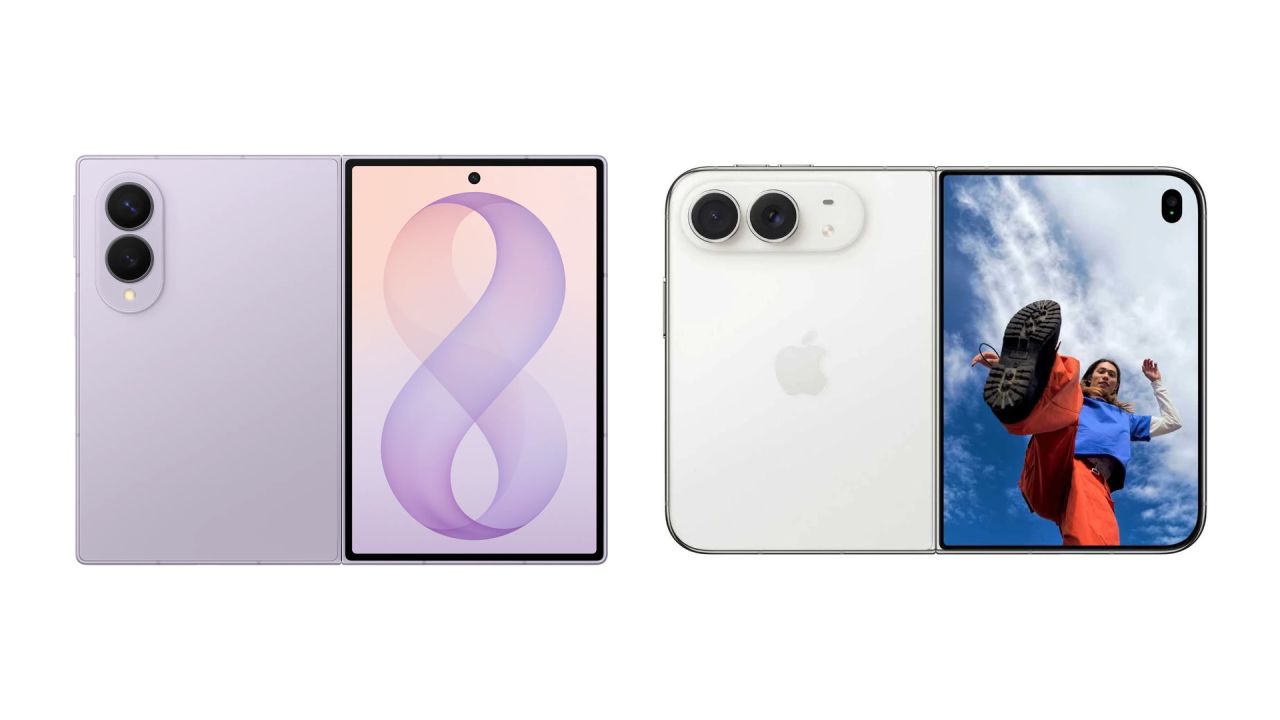
The Apple iPhone Duo and the Samsung Galaxy Z Fold8 solve the same problem, but they cut corners in different places. Apple invested in the frame materials, ingress protection and the finish of the inner panel, paying for it in weight and thickness. Samsung keeps its device lighter and slimmer, offers a wider video toolkit and openly states how long the hinge is rated to last, but gives up ground on protection. The choice here is not about screen size: it comes down to whether you value comfort in the hand and predictable, published specifications, or a tougher shell and the iOS ecosystem.
Build, weight and materials
The iPhone Duo is built around a Grade 5 titanium frame with a titanium hinge cover, Ceramic Shield 2 on the outer front and Ceramic Shield on the back. The Galaxy Z Fold8 uses an Advanced Armor Aluminum frame, Gorilla Glass Ceramic 3 over the cover display and Gorilla Glass Victus 2 on the rear panel. Titanium makes for a stiffer structure, but it does not make the phone lighter: the weight gap is obvious the moment you pick both up, 254 grams against 201.
Dimensions favour Samsung too. The Galaxy Z Fold8 is thinner both folded and open, while the iPhone Duo only claws back a slightly shorter body. For pocket carry and long one-handed reading the Fold8 is the easier device to live with, whereas the Duo feels denser and more solid. This difference is not cosmetic: if weight matters to you, this section alone settles the decision.
Displays
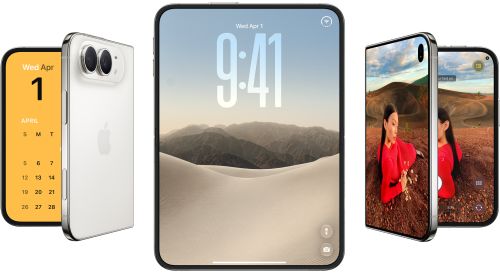
The inner panels share the same diagonal, both run adaptive refresh rates and both are rated for the same peak outdoor brightness. The Galaxy Z Fold8 uses Dynamic AMOLED 2X with a Flex Titanium layer beneath the flexible panel, which stiffens the screen around the fold. The iPhone Duo uses an OLED Super Retina XDR panel, and its cover display shares the aspect ratio of the inner one, so the interface does not have to rearrange itself when the phone closes.
The inner panel of the iPhone Duo carries a matte nano-texture finish that scatters reflected light instead of bouncing it back directly. Apple does not claim the crease is gone, only that this surface makes it harder to see.
In practice the surface is the only meaningful difference. The Fold8 keeps a glossy inner panel, so the fold line shows more readily at an angle and in bright light. Everything else is close enough that neither display should decide the purchase.
Only the iPhone Duo works with a stylus: Apple says support for the Apple Pencil (USB-C) will arrive in a firmware update later this year. The Galaxy Z Fold8 does not support a stylus at all.
Platform, memory and connectivity
The iPhone Duo runs the A20 Pro chip, built on a 2-nanometre process and mounted on a dedicated vapour chamber, under iOS 27. The Galaxy Z Fold8 uses the Snapdragon 8 Elite Gen 5 for Galaxy with Android 17 and the One UI 9 interface. Comparing clock speeds or benchmark points across iOS and Android is meaningless: both platforms sit at flagship level, and in daily use the difference comes from how each system handles a large screen, not from the silicon. Samsung does state how much RAM its phone has while Apple does not, so only one of the two lets you judge in advance how many apps will stay in memory.
The Galaxy Z Fold8 supports Samsung DeX: connect it to a monitor and you get a windowed desktop with its own interface. The iPhone Duo can only mirror what is already on the phone.
The two also differ in how they handle phone numbers. The iPhone Duo has no card tray and works with eSIM only, while the Galaxy Z Fold8 combines a nano-SIM slot with electronic profiles. All three major Ukrainian carriers support eSIM, so activation is not an issue, but moving a number to another handset or adding a local plan abroad has to go through the operator rather than by swapping a card. The verdict for this section is simple: the two are equally capable, so the decision falls to the ecosystem, not the spec sheet.
Cameras
The Galaxy Z Fold8 carries two rear modules, a stabilised wide and an ultra-wide with a 120-degree field of view. The iPhone Duo uses the same pairing, with a brighter main lens and sensor-shift stabilisation. Neither has a dedicated telephoto: both reach only double magnification without losing detail, after which digital zoom takes over. At this level that is a shared limitation, and it shows precisely when shooting distant subjects.
Video is where priorities diverge. The Galaxy Z Fold8 records in 8K, while the iPhone Duo tops out at 4K but records Dolby Vision in every mode and adds a cinematic mode with software depth control. The cover-display selfie cameras are roughly equal, but the Duo's under-display camera records video only in Full HD and Apple does not publish its resolution, so the Fold8 is the safer choice for long video calls on the big screen. Overall the two are close for stills, Samsung leads on maximum video resolution and Apple on HDR formats.
Battery life and charging
Here the comparison runs into incompatible measurements. Apple does not state battery capacity at all: the iPhone Duo uses a dual-cell design and the company describes endurance in hours of video playback, quoted separately for the inner and outer displays. Samsung instead publishes capacity in mAh. These figures cannot be reduced to a common measure, so neither of them proves an advantage.
Only the claimed charging speed can be lined up. Apple promises half a charge in around 20 minutes with a 60 W adapter or better, Samsung around 63 per cent in half an hour at 45 W. On paper the iPhone Duo looks quicker, but the tests were run under different conditions, so this is not a guaranteed win. The wireless charging gap is negligible, and in both cases the adapter is a separate purchase: only a cable comes in the box.
Protection, hinge life and support
The Galaxy Z Fold8 is rated IP48. The eight means full water protection, while the four means the body only blocks particles larger than a millimetre. Fine dust and sand are not kept out, and those are exactly what threatens a hinge. The iPhone Duo is rated IP68 with immersion to six metres for half an hour, which formally covers dust as well, a rarity among foldables. Both ratings come from laboratory testing and weaken over time as the seals wear.
Samsung rates the Galaxy Z Fold8 hinge for 500,000 folds. At a hundred openings a day that works out to more than ten years of use.
Apple publishes no fold rating whatsoever, even though the hinge is the defining component of this kind of phone. The gap the two share is a different one: neither company has announced the cost of replacing the inner panel or repairing the hinge, and on both devices the top layer of the inner screen is a soft polymer that a fingernail can scratch. Update transparency differs as well: Samsung commits to seven Android generations and seven years of security patches, while for the iPhone Duo Apple names neither a number of iOS versions nor a term, guaranteeing new iPhones a minimum of five years of security updates. The iPhone Duo leads on formal protection, the Galaxy Z Fold8 on how predictable its lifespan and support are.
The Galaxy Z Fold8 was announced on 22 July 2026 and went on sale on 7 August, starting at $1,899 for the 256 GB version. The iPhone Duo was unveiled on 9 September 2026, with pre-orders opening on 16 October and sales starting on 23 October; it starts at $1,999 for 256 GB and reaches $3,199 for the 2 TB configuration.
Specifications compared
iPhone Duo
Galaxy Z Fold8
Who each phone is for
The starting prices differ by a hundred dollars, roughly five per cent. Against the cost of the devices themselves that is not an argument that should decide anything: the gap buys back none of the missing features. The only genuinely expensive divergence is the two-terabyte iPhone Duo, which has no counterpart in the Galaxy Z Fold8 range at all.
The iPhone Duo makes sense if you already live in Apple's ecosystem, often carry a phone through dust or rain, and want a matte inner panel where the crease is harder to notice. For anyone who writes or sketches by hand, the promised stylus support adds a further reason.
The Galaxy Z Fold8 wins for buyers who care about weight and thickness, need a physical card slot, shoot in 8K, want a real desktop on an external monitor, or prefer a hinge with a published rating and a long guaranteed update term.
What they share is worth planning for: neither has a telephoto lens, neither protects its inner panel from scratches, and both ship without a charging adapter.