Huawei Unveils MatePad Air 2026 With a 144Hz OLED Display
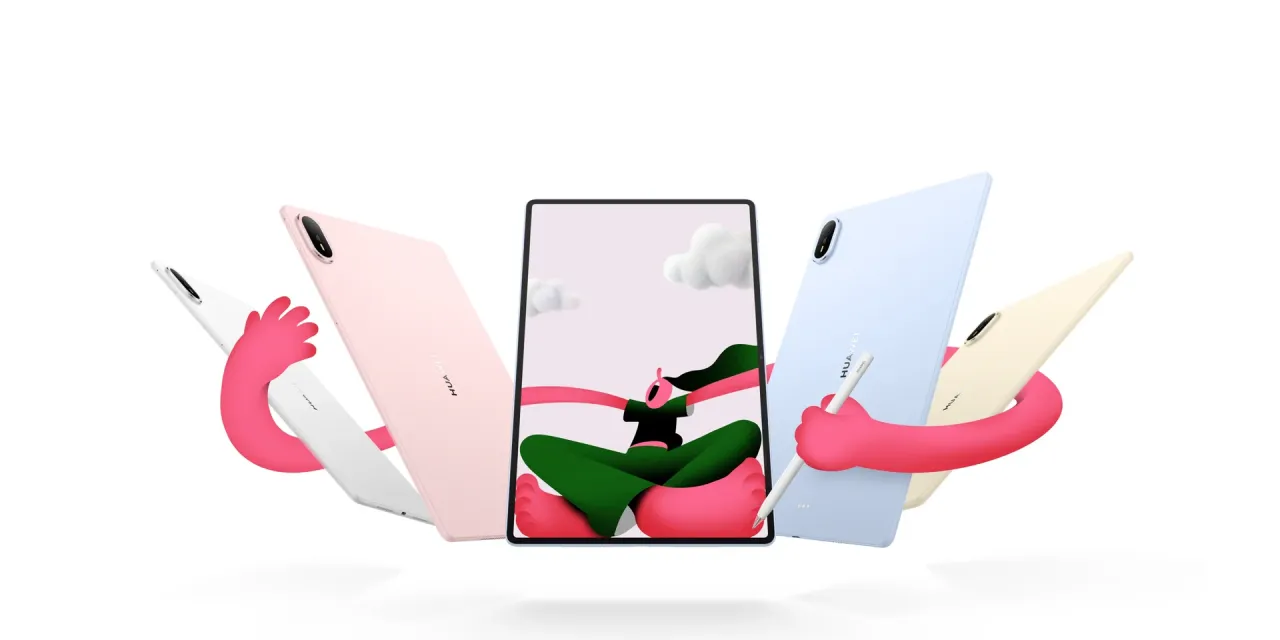
Huawei has refreshed its mid-range tablet family: the third-generation HUAWEI MatePad Air is the first model in the series to use an OLED panel instead of LCD. Along with the new screen, the tablet moves to the Kirin T93B processor and HarmonyOS 6.1, keeping the 12-inch format and a 5.3 mm chassis. For the Air line, positioned between the standard MatePad and the flagship MatePad Pro, this is the most substantial change in several generations.
From LCD to OLED, in two screen versions
The tablet uses a 12-inch panel with a resolution of 2800 × 1840 (275 PPI) and a refresh rate of up to 144 Hz. The aspect ratio is close to 3:2, which suits documents and handwritten notes better than a more elongated screen. Huawei lists P3 colour coverage, a 2,000,000:1 contrast ratio and factory calibration with a ΔE below one.
The two versions differ in finish and brightness. The standard model peaks at 1200 nits, while the PaperMatte variant reaches 2000 nits. Its glass is treated with a nano-etching process, and according to the manufacturer the surface suppresses glare without blurring the image as noticeably as conventional matte films. Both versions carry TÜV Rheinland certification, and the matte one adds an SGS certificate for low visual fatigue.
Performance and battery life
The tablet is built around the Kirin T93B, while the entry-level online version ships with the simpler Kirin T93C. According to Huawei's own lab measurements, overall performance is around 25% higher than last year's Air model. Heat is carried away by a vapour chamber and graphite layers routed towards the display and the back cover.
The 10,100 mAh battery charges in roughly 85 minutes with the bundled 66 W adapter, and local video playback runs up to 15.6 hours. Reverse wired charging at up to 18 W is also supported, so the tablet can top up a phone or a pair of earbuds.
AI features and stylus support
The software side is built around the voice assistant and Huawei's own notes app. Some of these features require an internet connection, and a few are promised in upcoming system updates rather than available at launch.
The Celia assistant takes notes during a lecture or meeting: it transcribes speech in real time, produces a short summary and lets the user attach a photo of the whiteboard to the note.
The system supports more than a hundred PC-class applications, including WPS Office with presentation generation and a mind-map editor, all usable in multi-window mode.
The M-Pencil Pro stylus detects the pen at a hover height of up to 12 mm, shows a tool panel as it approaches the screen and can turn pages remotely without touching the display.
The tablet was announced on 7 September and went on sale in China on 12 September; Huawei has not commented on a release in other markets.
Who the tablet is for
A 12-inch diagonal and a weight of 509 g make the MatePad Air a device for studying and reading rather than a compact tablet for daily commutes. The matte version suits anyone who writes by hand or reads for long stretches, since it reflects noticeably less under indoor lighting and outdoors. Six speakers and 15 hours of video playback strengthen the entertainment case, and the magnetic keyboard turns the tablet into a workable tool for light document work.
The limitations matter too. The device is sold only in a Wi-Fi configuration, has no satellite navigation module and runs HarmonyOS without Google services, so familiar Android apps have to be found in Huawei's own catalogue or replaced with alternatives. Owners of Huawei phones get the most out of it, thanks to tap-to-transfer file sharing and shared use of the phone's SIM cards.
Competitors and where it wins
In its price bracket the MatePad Air competes mainly with the 13-inch Apple iPad Air, the Samsung Galaxy Tab S11 and the OnePlus Pad 3. Huawei's strongest argument is the screen. The comparable iPad Air still relies on a 60 Hz LCD panel and weighs 616 g at 6.1 mm thick, whereas the MatePad Air offers OLED at 144 Hz in a 5.3 mm, 509 g body. Apple's nano-texture matte glass is reserved for the higher-end iPad Pro models and costs considerably more.
Against the Galaxy Tab S11, the Huawei tablet wins on screen size, and its 66 W charging remains among the fastest in the class. Samsung and OnePlus, on the other hand, offer full Android with Google services and a wider app selection, and the OnePlus Pad 3 has an even larger battery. The decision comes down less to specifications than to ecosystems: on hardware the MatePad Air looks stronger than most rivals at its price, while on software it remains an option mainly for people already using Huawei devices.
Chinese pricing starts at CNY 4,499 (~$630) for the online 8/256 GB version and rises to CNY 6,899 (~$970) for the matte-screen model with 12/512 GB.
Specifications
- Display: 12" OLED, 2800 × 1840 (275 PPI), up to 144 Hz, P3, 2,000,000:1 contrast, 1200 nits (standard) or 2000 nits (PaperMatte)
- Processor: Kirin T93B (Kirin T93C in the entry-level online version)
- Operating system: HarmonyOS 6.1
- Memory: 8 or 12 GB RAM, 256 or 512 GB storage
- Cameras: 50 MP main (f/1.8, autofocus, flash), 12 MP front (f/2.4)
- Battery: 10,100 mAh, 66 W charging, reverse wired charging up to 18 W
- Audio: six speakers, two microphones, HUAWEI SOUND
- Connectivity: Wi-Fi 7+, Bluetooth 6.0, NearLink E2.0, USB-C (USB 3.1 Gen 1)
- Positioning: Wi-Fi network positioning only
- Dimensions and weight: 271.6 × 182.9 × 5.3 mm, 509 g (520 g for the PaperMatte version)
Airy Blue Early Summer Lemon Sakura Pink Warm Cloud White Smoky Cloud Gray