Honor Robot Phone: Flagship With a Moving Gimbal Camera and Yoyo AI
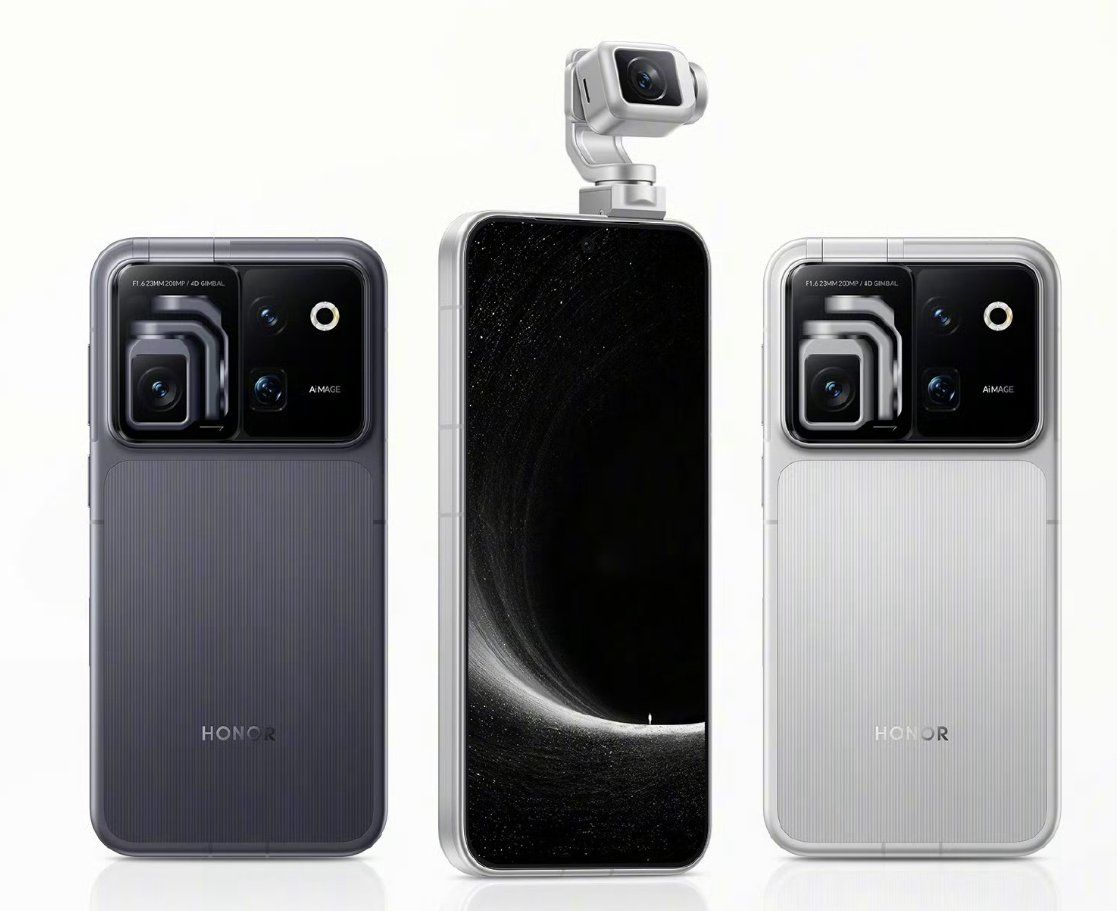
Honor has officially launched the Robot Phone in China — an Android flagship whose main camera sits on a moving gimbal built directly into the body. The device was first mentioned during the Magic8 series announcement in October last year, and an early prototype was shown at CES. The company has now revealed the final specifications, and the phone also arrives as the first product of Honor's partnership with German cinema equipment maker ARRI.
The Honor Robot Phone was officially unveiled on 12 August 2026 and goes on sale in China.
A gimbal inside the body
The stabilisation mechanism is built around a titanium assembly: the gimbal motor weighs 2.6 g and is only 6 mm thick, which allows the entire system to fit inside a 9.6 mm body. There is still a trade-off — the phone weighs 248 g, noticeably more than a conventional flagship.
Honor describes the mechanism as the industry's smallest 4D gimbal — according to the company, it is 65% more compact than traditional stabilisers such as those used in the DJI Osmo Pocket series.
The manufacturer illustrates the complexity of assembly with numbers: over 60 production processes, more than 100 precision components and over 100 patents involved in developing the module.
Camera and video
The gimbal carries a 1/1.28" sensor with 200MP resolution and an f/1.6 aperture. The module records video at up to 4K and works alongside Honor's own H1 imaging chip. Shooting settings can be adjusted by voice — asking the gimbal to turn around or focus on a specific point, for example. Honor also lists AI subject tracking with real-time auto-framing, aimed at vlogging, livestreaming and video calls.
The Robot Phone is the first handset of the ARRI partnership: it offers native Log-C3 encoding, on-device LUT colour grading and a dedicated cinema mode that replicates the look of the brand's cinema cameras.
More than a camera
The gimbal also acts as a robot companion driven by the Yoyo assistant: it can observe its surroundings, interact with them and carry out tasks on its own, and it performs over 100 facial expressions — from nodding and peeking to dancing along to music.
That capability explains the name of the device: Honor positions the moving module not as a conventional stabilisation system, but as a separate way of interacting with the phone.
Other cameras and hardware
Alongside the gimbal module, the Robot Phone carries a 200MP periscope telephoto camera with a 1/1.4" sensor and 2.7x optical zoom, plus a 50MP ultrawide camera that doubles as a macro shooter.
The front is taken up by a 6.3-inch LTPO OLED screen with a 2,640 x 1,216 resolution and a variable refresh rate between 1 and 120 Hz. Peak local brightness is rated at 6,800 nits, and the panel uses an AR anti-reflective coating.
Performance comes from the Snapdragon 8 Elite Gen 5 paired with up to 16 GB of RAM and up to 1 TB of storage. The phone runs MagicOS 10 based on Android 16. Battery life is handled by a 7,060 mAh silicon-carbon cell with 120 W wired and 50 W wireless charging.
Specifications
- Display: 6.3" LTPO OLED, 2,640 x 1,216, 1–120 Hz, 6,800 nits peak local brightness, AR coating
- Chipset: Snapdragon 8 Elite Gen 5
- Memory: up to 16 GB RAM, up to 1 TB storage
- Gimbal camera: 200MP, 1/1.28" sensor, f/1.6, up to 4K video, H1 imaging chip
- Telephoto: 200MP periscope, 1/1.4" sensor, 2.7x optical zoom
- Ultrawide: 50MP, doubles as macro
- Video formats: Log-C3, on-device LUT grading, ARRI cinema mode
- Battery: 7,060 mAh, silicon-carbon
- Charging: 120 W wired, 50 W wireless
- OS: MagicOS 10 based on Android 16
- Thickness and weight: 9.6 mm, 248 g
Silver Gray